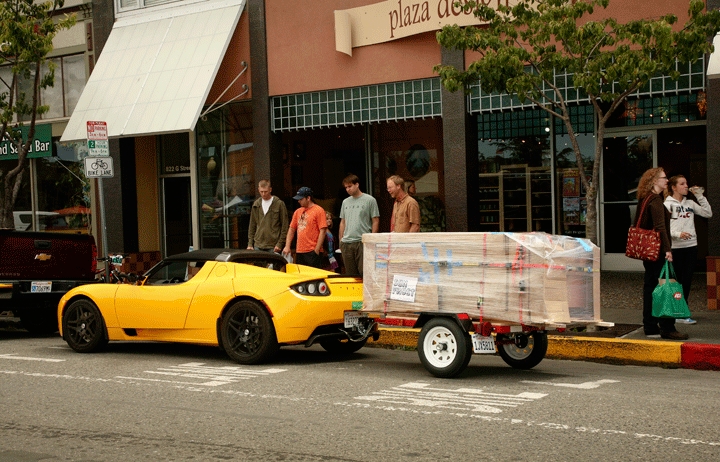
Here we go, the only way to have your Electric Vehicle charged!
Showing posts with label 2011 Nissan Leaf. Show all posts
Showing posts with label 2011 Nissan Leaf. Show all posts
Friday, May 11, 2012
Q1 2012 Shows Sales of Fuel-Efficient Hybrids and Plug-In Vehicles Soaring
We already know that April was a great month for Toyota Prius hybrid sales, but it turns out that the first quarter of the year produced stellar sales numbers for hybrids in general, as well as plug-in electric cars.
More than 100,000 hybrids and plug-in cars--113,457--were sold in January, February, and March combined, against roughly 79,000 in the same period of 2011.
The vast bulk of those sales--106,207--were hybrids, of course.
The hybrid sales included not only much higher sales of the Toyota Prius, now a lineup of three models plus a plug-in, but also Buicks and Chevrolets fitted with the General Motors eAssist mild-hybrid system.
All varieties of plug-in cars accounted for 7,250, according to data compiled by industry trade journal Automotive News.
Plug-in sales totaled about 17,000 units for all of 2011, the bulk of them either the Nissan Leaf battery-electric vehicle or the Chevrolet Volt range-extended electric car.
For 2012, the strong new plug-in entrant is the 2012 Toyota Prius Plug-In Hybrid, whose April sales beat those of both the Volt and the Leaf.
Analysts expect perhaps 30,000 to 40,000 plug-in cars to be sold in the U.S. during calendar 2012, against perhaps 400,000-plus conventional hybrids.
As always, the bulk of the hybrid sales will come from Toyota.
Source: Green Car Reports
More than 100,000 hybrids and plug-in cars--113,457--were sold in January, February, and March combined, against roughly 79,000 in the same period of 2011.
The vast bulk of those sales--106,207--were hybrids, of course.
The hybrid sales included not only much higher sales of the Toyota Prius, now a lineup of three models plus a plug-in, but also Buicks and Chevrolets fitted with the General Motors eAssist mild-hybrid system.
All varieties of plug-in cars accounted for 7,250, according to data compiled by industry trade journal Automotive News.
Plug-in sales totaled about 17,000 units for all of 2011, the bulk of them either the Nissan Leaf battery-electric vehicle or the Chevrolet Volt range-extended electric car.
For 2012, the strong new plug-in entrant is the 2012 Toyota Prius Plug-In Hybrid, whose April sales beat those of both the Volt and the Leaf.
Analysts expect perhaps 30,000 to 40,000 plug-in cars to be sold in the U.S. during calendar 2012, against perhaps 400,000-plus conventional hybrids.
As always, the bulk of the hybrid sales will come from Toyota.
Source: Green Car Reports
Friday, May 4, 2012
Chevrolet Volt Records Third Best Sales Month
With April Volt sales numbers in, GM reported 1,462 units sold in a month with three fewer selling days than March.
This total is down from the Volt’s second-highest sales figures in December, in which 1,529 were sold, and down also from the March record of 2,289.
Last month we had heard some from GM say they were not expecting April Volt sales to exceed March, although CEO Dan Akerson has been quoted as saying he’d like to see somewhere between 2,000-3,000 month after month going forward.

Some industry watchers have speculated also that GM’s California Volts are still in a transition period of changing over to solo-HOV-lane eligible Electric Advanced Technology Partial Zero-Emissions Vehicle (eAT-PZEV) versions, and this could have put a crimp in the progress.
But if GM sold fewer than some hoped for, Nissan could be said to be looking worse, with just 370 battery electric Leafs sold in April. This is down from 579 units in March and 478 in February. In fact 370 is lower than the 573 Leafs Nissan delivered in April 2011. The Leaf’s best sales month was June, 2011 with 1,708 sold.
Nonetheless, ever-optimistic Nissan CEO Carlos Ghosn said industry watchers should not let a few mediocre months influence their perspective. He is keeping a long-term view, unwaveringly saying BEVS will comprise 10 percent of the market by decade’s end.
Things ought to pick up also, he said, as Nissan begins building the Leaf in Tennessee in late 2012, and the UK in early 2013.
As for the Volt, it was not a bad month, and being lower than the last month which happened to be a record does not add up to a negative trend.
Indeed, GM is doing what it said it would in building to meet demand, and has been producing them in decent numbers.
Further facts of interest are that for the 2012 calendar year to date, Detroit-Hamtramck has built 5,095 Volts and 3,382 Opel Amperas.
For 2012 model year to date, the assembly plant has so far turned out 16,336 Volts and 5,987 Amperas.
Ampera sales reported for April were 557 total units.
Source: GM-Volt.com
This total is down from the Volt’s second-highest sales figures in December, in which 1,529 were sold, and down also from the March record of 2,289.
Last month we had heard some from GM say they were not expecting April Volt sales to exceed March, although CEO Dan Akerson has been quoted as saying he’d like to see somewhere between 2,000-3,000 month after month going forward.

Some industry watchers have speculated also that GM’s California Volts are still in a transition period of changing over to solo-HOV-lane eligible Electric Advanced Technology Partial Zero-Emissions Vehicle (eAT-PZEV) versions, and this could have put a crimp in the progress.
But if GM sold fewer than some hoped for, Nissan could be said to be looking worse, with just 370 battery electric Leafs sold in April. This is down from 579 units in March and 478 in February. In fact 370 is lower than the 573 Leafs Nissan delivered in April 2011. The Leaf’s best sales month was June, 2011 with 1,708 sold.
Nonetheless, ever-optimistic Nissan CEO Carlos Ghosn said industry watchers should not let a few mediocre months influence their perspective. He is keeping a long-term view, unwaveringly saying BEVS will comprise 10 percent of the market by decade’s end.
Things ought to pick up also, he said, as Nissan begins building the Leaf in Tennessee in late 2012, and the UK in early 2013.
As for the Volt, it was not a bad month, and being lower than the last month which happened to be a record does not add up to a negative trend.
Indeed, GM is doing what it said it would in building to meet demand, and has been producing them in decent numbers.
Further facts of interest are that for the 2012 calendar year to date, Detroit-Hamtramck has built 5,095 Volts and 3,382 Opel Amperas.
For 2012 model year to date, the assembly plant has so far turned out 16,336 Volts and 5,987 Amperas.
Ampera sales reported for April were 557 total units.
Source: GM-Volt.com
Saturday, April 28, 2012
Model X will have excellent towing capability. Despite photo, Model S will not offer option

 The Roadster, of course, doesn't come with a towing option (though the company's CTO JB Straubel does have a hitch on his) and the Model S wasn't slated to offer the option as far as we knew. So, we contacted the California automaker to ask what's up.
In a brief response, a spokesperson said "Tesla's engineering vehicles are constantly undergoing internal testing in a wide variety of circumstances to fine tune and validate performance, safety and durability" and confirmed that there will be no factory towing option. Of course, the Nissan Leaf didn't offer that function either but the aftermarket has stepped in with a solution.
So, if you want an all-electric that will pull your boat over to the bay, what are your options? A Leaf might not have the wherewithal for that sort of heavy-duty application, but there is something coming that will. The Tesla Model X (inset). According to the same spokesperson, "Model X will have towing capability exceeding most SUVs in its class. With all-wheel drive, incredible torque and sophisticated traction control, it will be an excellent towing machine."
Source: Autoblog Green
Wednesday, April 25, 2012
General Electric CEO says electric vehicles will reach 'tipping point'
 True belief or wishful thinking?
That's the question some may ask about General Electric CEO Jeff Immelt and his statement that electric vehicles will become more than a just niche market in the U.S.
Immelt, speaking at a Detroit automotive conference on Tuesday, said GE will continue to invest in battery-electric vehicle technology with the belief that lower costs and improved performance will allow EVs to reach "a tipping point," Reuters reported. Immelt stressed the fact that GE's decision was based on his belief in what will be a substantial market, adding that "novelties don't work."
Last year, electric-drive vehicles such as the Chevrolet Volt extended-range plug-in and Nissan Leaf battery-electric accounted for less than one in 500 new cars sold. By comparison, hybrids account for about one in 50 new cars sold.
GE was an early supporter of electric-drive vehicles, agreeing in November 2010 to order 12,000 Volts and work with its fleet customers to purchase 10,000 more electric-drive vehicles by 2015. GE said at the time that electric-drive vehicle adoption could create $500 million in revenue for the company during the ensuing three years.
Source: Autoblog Green
Tuesday, April 24, 2012
Nissan's Venucia JV will build Leaf look-alike electric car in China by 2015

PRESS RELEASE
Dongfeng Nissan Passenger Vehicle Company ("Dongfeng Nissan"), the Passenger Vehicle business unit of Nissan's joint venture with Dongfeng Motor Corporation, today launched D50, the first production model of the company's new VENUCIA brand, at the Beijing Motor Show.
D50 is powered by a 1.6-liter gasoline engine, and four grades are available with prices ranging between RMB 67,800 and RMB 83,800. The car is built at the new Zhengzhou plant to global standards of quality and will be available at 100 exclusive VENUCIA dealers nationwide. D50's features include a spacious interior and a powertrain that delivers both high performance and fuel economy.
"The launch of 'D50' is a new start for us," said Ren Yong, deputy managing director of Dongfeng Nissan. "We will continue to enhance our engineering capability and launch a new model every year. Our objective for VENUCIA is to reach sales of 1 million units over the next five years."
Another highlight was the unveil of the brand's very first EV concept vehicle, "e-concept". "e-concept" will be built locally in China under the VENUCIA brand by 2015.
The sales target for VENUCIA will be 300,000 units annually, with a target of five models and 250 outlets by 2015.
The brand name, VENUCIA, is derived from the ancient Roman "Venus." The five stars of the brand logo represent the company's five brand promises - respect customers, create value, do the best, achieve world-class quality and seek the dream.
About Dongfeng Nissan Passenger Vehicle Company (Dongfeng Nissan)
Dongfeng Nissan is a business unit of Dongfeng Motor Co., Ltd., Nissan's joint venture with Dongfeng Motor Group Co., Ltd. Dongfeng Nissan is engaged in research and development operations, manufacturing and distribution of passenger vehicles.
Nissan Global Company Limited ("NGL") is a fully owned subsidiary of Nissan Motor Co., Ltd., the second-largest Japanese automotive company. NGL was established in April 2012 in Hong Kong as the new Global Headquarter of the Infiniti brand. NGL also plays an important role in market research, product planning, and marketing and communications for the Nissan brand for Asia. Taking into account the geographical benefits of Hong Kong, the establishment of NGL is a key strategic milestone to realize the goals of Nissan Power 88, Nissan's corporate mid-term business plan.
Saturday, April 21, 2012
Nissan predicts Leaf sales jump, says diesels are unlikely

Nissan is expecting annual U.S. sales of its battery-electric Leaf to jump sixfold between 2011 and 2013 but is downplaying the possibility of selling a diesel-powered vehicle, Car and Driver said, citing company executives.
The Japanese automaker, which sold just under 9,700 Leafs last year, may more than double sales to 22,000 units this year and may surpass the 60,000-vehicle mark in 2013, according to Al Castignetti, a Nissan vice president and general manager. Nissan also said it was looking into plug-in hybrid-electric powertrains, but no specifics about timeframe or model were given.
As for diesels, Nissan once said (in 2007) that it would start selling a diesel-powered Maxima in 2010, but it is no longe likely to pursue that type of powertrain because of government restrictions and cost concerns, Pierre Loing, Nissan vice president for product strategy and planning told Car and Driver.
German automakers such as Volkswagen, Audi and Mercedes-Benz have relaunched diesel sales in the U.S. in recent years after decades of improving their performance in Europe. Meanwhile, General Motors said last year that it will introduce a diesel-powered Chevrolet Cruze to the U.S. next year. So far, Americans seem to be enjoying the option.
Source: Autoblog Green
Tuesday, April 17, 2012
EV Battery costs down 14% from one year ago and 30% since 2009

Electric-vehicle lithium-ion battery-pack costs fell 14 percent during the past year and are down 30 percent from three years ago because of technological improvements and increased production capacity, Bloomberg News reports, citing a study from its sister entity Bloomberg New Energy Finance.
EV battery costs fell to $689 per kilowatt hour (kWh) during the first quarter, down from $800 per kWh a year earlier. Bloomberg New Energy Finance also estimates that the battery industry has the capacity to supply as many as new 400,000 battery-electric vehicles this year, and that number may jump to almost 700,000 by the end of next year. Global vehicle makers sold about 43,000 EVs last year.
Lithium-ion battery costs are important because they can account for 25 percent or more of an EV's total costs, and estimates have varied widely. Last month, green-technology firm Pike Research estimated that lithium-ion battery costs may fall by about a third to $523 per kWh by 2017, while the battery pack for the Nissan Leaf EV has been reported to cost as little as $375 per kWh. The U.S. Advanced Battery Consortium has said battery costs will have to fall to about $150 per kilowatt hour for EVs to be price-competitive with conventional vehicles.
Source: Autoblog Green
Friday, April 13, 2012
Fleet Forum and Nissan launch EV demonstrator program

Fleet Forum and Nissan launched the Electric Vehicle Demonstrator Program which provides free use of the new Nissan Leaf all-electric car to five organizational members of Fleet Forum. Fleet Forum is a collaborative association that includes NGOs, international organisations, the United Nations, academic institutions, donors, and corporate partners and is dedicated to the improvement of transportation performance in road safety, cost efficiency and environmental impact.
Among more than 50 members of Fleet Forum, 5 international aid organisations were selected as official participants and will start in Switzerland, Italy and UK. These organisations are the United Nations World Food Programme; the International Committee of the Red Cross and Red Crescent; the United Nations High Commissioner of Refugees; Islamic Relief; and the United Nations Logistics Base.
The new EV program aims to give aid and development organisations first-hand experience of the benefits of using electric vehicles as a way of improving efficiency while also reducing costs and minimizing environmental impacts.
Under a Memorandum of Understanding signed between Nissan and Fleet Forum, Nissan has agreed to lend five Nissan LEAFs to the Fleet Forum member organizations for a year free of charge. The Fleet Forum will rotate the vehicles among official participants for six months each in order for them to experience the benefits and practicability of a zero-emission vehicle and to encourage them to switch to such vehicles for their environmental fleet management. After 12 months of free loaning, Nissan and Fleet Forum will then review feedback from the participants.
Source: Green Car Congress
Monday, April 9, 2012
Nissan Updates Software to Eliminate Range Guesstimates

Ever since Nissan launched its Leaf electric hatchback in late 2010, owners around the world have struggled with its on-board Carwings telematics system.
Responsible for everything from initiating remote charging and cabin pre-conditioning through to predicting remaining range and finding charging stations, Carwings hasn’t always been that reliable...or accurate.
Now Nissan is promising an upcoming software update to the Carwings system found in every Nissan Leaf, drastically improving the range prediction algorithms that are responsible for what many Leaf owners have unceremoniously dubbed the “Guess-O-Meter”, or range gauge.
In addition, Nissan says a future update will allow Leaf owners to use Carwings to check the availability of a charging station before they arrive, further improving the experience of driving its electric car.
Guess-O-Meter?
Current and previous versions of the Nissan Leaf’s on-board software rely on fairly crude information, such as battery state-of-charge and current power demands, to predict how much range is remaining at any given point.
Driving at a fixed speed on an unchanging road at a uniform temperature, Nissan’s latest Leaf software can give reasonable range predictions. Hit a large hill during the middle of a satellite-navigation-aided trip, and you’ll hear the following range-anxiety-inducing words:

2012 Nissan Leaf 4-door HB SL Instrument Panel
“You might not be able to reach your destination. Push button to check.”
With the upcoming update, Nissan claims that new Carwings algorithms, alongside Internet-based information retrieved at regular intervals during a trip, will give drivers much more accurate range predictions.
Is there anyone there?
With more charging stations being installed across the U.S. capable of smart-grid connectivity, Nissan is also promising to help reduce the risk of turning up at a charging station to find it is in use already, or broken.
As part of its future plans, Nissan says it is working with select charging station providers to relay information about each individual charging station to Leaf owners.
Soon it says, Leaf owners will be able to check on the status of charging stations provided by select partners, ensuring that Leaf owners will know that detour to a nearby charging station isn’t in vain.
No set date

2011 Nissan Leaf Software Update
Combined, these two important updates to the Nissan’s Carwings service should make driving its Nissan Leaf longer distances much less scary to first-time electric car owners.
But while it will no doubt help combat range anxiety, Nissan hasn’t yet given a date for when these updates will be pushed to 2011/12 Nissan Leafs already on the road.
Source: Green Car Reports
Wednesday, April 4, 2012
Carlos Ghosn: 27,000 Nissan Leafs sold worldwide; many, many more to come

Carlos Ghosn is not backing down.
Giving the keynote speech at the 2012 New York Auto Show today, the president and CEO of Nissan said that he stands behind his prediction that EVs will make up 10 percent of the market by 2020 in the places they are available. He also said that he expects Nissan to sell 1.5 million zero emission cars by 2016.
Ghosh brushed off a question about somewhat slow Leaf sales by pointing out that the Leaf is still constrained by supply, given the earthquake and tsunami in Japan last year as well as the strong yen. Leaf production in the UK and U.S. that will start in the near future (later this year for Tennessee, early 2013 for Sunderland) will make the car more available to more people. "I don't want you to take a one-month or two-month sales result in one particular market to try to make your opinion about the evolution of a very important technology for the industry," he said. "I think the electric car will hold its promises. All the stars are lining up to make it a very important segment. ... I am not at all changing my bullish approach."
Ghosn has reason to be bullish. Nissan has sold 27,000 Leafs worldwide since introducing the car in late 2010, and 11,000 of those sales were in the U.S. And, he added, "The Nissan Leaf has had no quality problems."
Looking forward, Ghosn also said that the challenge is to reduce the cost, size and weight of the battery and "we have to do it fast" because government incentives will not last forever. Luckily, the industry has changed enough in the last half-decade to make this possible. He said:
One of the biggest evolutions we are seeing in our industry is the battery. As you know, when we started our electric car goals, it was in 2006, there were not a lot of battery makers in the world. Fortunately, with our drive and with the drive of other carmakers, the number of battery makers and companies investing in batteries has really been impressive. Today, you can find very good batteries, extremely competitive, in Korea, in Japan, in the United States. The Chinese are investing in batteries. ... The life of the battery is going to be longer than the life of the car.
Source: Autoblog Green
Tuesday, March 20, 2012
Ghosn confirms return of Datsun brand; targeting high-growth markets
Nissan CEO Carlos Ghosn announced the return of the Datsun brand as Nissan’s third global brand, alongside Nissan and Infiniti. Nissan had phased out the brand in 1986. Nissan will target Datsun models on “optimistic up-and-coming customers” in high-growth markets, he said. Datsun vehicles will start sales in India, Indonesia, and Russia from 2014.
Ghosn made the announcement during remarks on a trip to Jakarta, Indonesia to announce measures to strengten Nissan’s production base and sales presence there.
Nissan’s total capacity will increase to 250,000 annually there by 2014, with the workforce expanding to 3,300, and sales outlets are planned to increase to 150 by 2015.
The new plan will make Nissan’s Cikampek site, located 80 kilometers outside of Jakarta, one of the largest production facilities in the ASEAN region for Nissan.
In 2011, 890,000 vehicles were sold in Indonesia, for the first time making the nation ASEAN’s largest car market. Nissan is in line to achieve its sales objectives of 60,000 units for fiscal year 2011. Indonesia total industry volume is estimated to increase nearly double by 2017 compared to 2010, largely driven by the introduction of the Green Car program now being drafted by the Indonesian government. Nissan strongly supports the program and looks forward to its speedy ratification.
On 19 March, Ghosn met Indonesia president Susilo Bambang Yudhoyono and reiterated Nissan’s commitment to the nation’s motorization.
Source: Green Car Congress
Ghosn made the announcement during remarks on a trip to Jakarta, Indonesia to announce measures to strengten Nissan’s production base and sales presence there.
Nissan’s total capacity will increase to 250,000 annually there by 2014, with the workforce expanding to 3,300, and sales outlets are planned to increase to 150 by 2015.
The new plan will make Nissan’s Cikampek site, located 80 kilometers outside of Jakarta, one of the largest production facilities in the ASEAN region for Nissan.
In 2011, 890,000 vehicles were sold in Indonesia, for the first time making the nation ASEAN’s largest car market. Nissan is in line to achieve its sales objectives of 60,000 units for fiscal year 2011. Indonesia total industry volume is estimated to increase nearly double by 2017 compared to 2010, largely driven by the introduction of the Green Car program now being drafted by the Indonesian government. Nissan strongly supports the program and looks forward to its speedy ratification.
On 19 March, Ghosn met Indonesia president Susilo Bambang Yudhoyono and reiterated Nissan’s commitment to the nation’s motorization.
Source: Green Car Congress
Wednesday, March 14, 2012
Friday, March 9, 2012
Nissan will double Tennessee workers for Leaf, battery-pack ramp-up

Nissan will almost double the number of workers at its factory in Smyrna, TN, within the next year in part to ramp up production of both Nissan Leaf electric vehicles and battery packs, HybridCars reports.
Nissan will add 1,300 workers specifically for the battery packs and for the Leafs, which will start being built in the U.S. later this year. The Japanese automaker has invested $1.7 billion upgrading the plant, which will include a 1.3-million-square-foot facility dedicated to making battery packs. In all, Nissan will employ about 6,000 at the factory by early next year.
With the improvements, Nissan's plant in Smyrna, about 25 miles southeast of Nashville, will be able to produce as many as 200,000 Leafs and 150,000 battery packs a year. Last month, Nissan sold 478 Leafs in the U.S., marking a sevenfold increase from a year earlier though down from the 676 Leafs sold in January. In 2011, Nissan sold 9,674 Leafs, slightly less than the company's target of 10,000 units for its first full year of U.S. sales.
Sunday, March 4, 2012
Owner Explains Why he Purchased Plug-in Prius versus Volt and Leaf

Last month, Toyota said that it had 2,100 pre-orders for the 2012 Prius Plug-In Hybrid.
Now, with first sales of that car being logged this week and dozens of them delivered to dealers, we have a third viable, high-volume plug-in car available to U.S. buyers.
Consumers can now buy a pure battery electric vehicle (the Nissan Leaf), a range-extended electric (the Chevy Volt), or the first plug-in hybrid (the plug-in Prius).
Their EPA electric ranges are 73 miles for the Leaf, 35 miles for the Volt, and 11 miles for the Prius Plug-In. Each is priced between $32,500 and $40,000 before incentives.
Given all that, we'll be very curious to see what the sales mix of these three plug-ins turns out to be--and how buyers evaluate each car against the other two.
One reader and early buyer of a Prius Plug-In Advanced model, Jim Bradbury of Rowlett, Texas, agreed to share his thoughts with us:
I test drove a Nissan Leaf, which is a little small. The range anxiety kept me from buying one. I liked its dash and the futuristic sounds.
It's nice to know I can drive the Plug-In Prius across country, and where there IS a charging station along the way, I can charge up and save a little gas.
What helped make the decision against the Leaf is the fact that DFW Airport is 43 miles from my home. I can't make it there and back in a Leaf, even on a full charge, but I can in the Plug-In Prius.
As for the Chevrolet Volt, I test-drove it. It's only a four-seater; the Prius has five seats. And I'm a big guy, so it was harder for me to get in and out of the Volt. There's more headroom in a Prius than a Volt.
While the Volt will go up to 40 miles in electric mode, the engine doesn't drive the wheels, and the Volt only gets 36 miles per gallon when it runs out of battery--while the Prius Plug-In gets 50 MPG.
Finally, the Chevy Volt looks too much like an ordinary car. The Prius Plug-In and Leaf are both unique looking and make a statement about "Being Green". The Volt looks too much like a Chevy Cruze, and the average person doesn't notice the difference.

2012 Toyota Prius Plug-In Hybrid - production model
But the Leaf and the Volt are both good cars. I spent a lot of time looking at the cars and their features. I have test driven a Prius twice now, and it's a fun car to drive.
I wish the Prius had a bigger battery so it could go 20 miles or more in all-electric mode, but it's only 3 miles from my home to the grocery store, the bank, and the post office.
So, the 11+ miles of electric range for the Plug-In Prius is adequate to run those errands in pure EV mode.
I teach at a community college 11 miles from the house. There are charging stations at a recreation center 2 miles from the college where I can charge my car on the way home while I exercise. I won't use much gas on those 23-mile round trips.
I'm a Digital Systems Engineer and I like the Prius from an engineering perspective. The regular hybrid Prius has been around for 13 years, and has a proven track record for quality and reliability.
And there you have it: one man's clearly articulated reasons for choosing the 2012 Toyota Prius Plug-In Hybrid over a Leaf or a Volt.
Source: Green Car Reports
Thursday, February 2, 2012
Chevy Volt sales drop to 603, Nissan moves 676 Leafs in January

This one has got to hurt. After a record-best 1,529 units sold in December, sales of the Chevrolet Volt dropped to just 603 in January, part of an overall decline in GM model sales compared to the last month of 2011. The good news in this less-than-half drop? If you look at the year-on-year trend, the Volt almost doubled its sales. In January 2011, Chevy sold 321 Volts.
Over on the Nissan Leaf side, the numbers are also down. Nissan sold 676 Leafs in January, which is less than the 954 Leafs sold last month. But, if we do the same comparison that we did with the Volt, things look good. All the way back in January 2011, Nissan sold 87 Leafs. For more on Leaf sales, read this. We'll have our By The Numbers post on overall green car sales up as the information rolls in.
Source: Autoblog Green
Sunday, January 29, 2012
A word on Nissan Leaf sales, orders and reservation numbers

What's up with the sales, orders and reservations of the Nissan Leaf? Nissan loudly trumpeted the 20,000 reservations it originally collected back in September, 2010 and Nissan's Mark Perry recently told AutoblogGreen that, since then, that number has climbed to around 26,000. Where do things stand today? That's not exactly simple to figure out. Here's what we know:
- Number of accepted Leaf reservations: 26,000
- – Number of Leaf models sold: 10,000
- – Number sold in January: 800 (estimate)
- – Number sold in February: 800 (estimate. Perry recently said these two months were sold out or nearly sold out)
- – Number of people who haven't had a chance to order because they live in a state where the Leaf is not yet for sale: 2,000 (according, again, to Perry)
- – Number of people who cancelled (unknown)
- = 12,400 people or so
One thing that Zachary was willing to share were the colors chosen by buyers for model year 2012 Leaf orders. They are:
- Brilliant Silver – 24%
- Blue Ocean – 23%
- Glacier Pearl – 21%
- Cayenne Red – 19%
- Super Black – 14%
Source: Autoblog Green
Tuesday, January 24, 2012
Driving the Nissan Leaf in Cold and Snow

Prior to this winter, Nissan has only sold its all-electric Leaf hatchback to customers in moderate climates.
But just as Nissan North America was celebrating selling its 10,000th Leaf, Nissan Japan was proving that the Leaf wasn’t scared of winter weather with a special press event held near the northern city of Shibetsu, Hokkaido.
With ambient temperatures averaging just 15.8 degrees Fahrenheit, Nissan invited Japanese automotive journalists to test the handling and performance of the Leaf in frigid temperatures.
Despite the cold outside temperatures, Nissan technicians reported the temperature of each test car’s battery packs used never dropped below 41 degrees Fahrenheit, illustrating that at worst, the battery packs were only slightly below optimum operating temperature.
More impressively, not a single test car was fitted with the on-board battery heating system now fitted as standard to U.S. market Leafs. According to Nissan, the temperatures in Shibetsu were not cold enough to warrant using battery heating.
Despite low traction conditions caused by snow and ice, many of the journalists taking part reported that they were surprised at how well the Leaf handled the three powdery courses.
According to Nissan Technical guru Hiroyoshi Kato, the Leaf's good road manners in bad weather are a direct result of its design.
“The footwork of the Leaf is smooth and nimble because the heavy components, such as batteries, are mounted under the floor, and the center of gravity is low and in the middle,” he explained. “As you may have seen, a car can easily slip or drift on snow or ice. As for the Leaf, the changing attitude of the car -- the start of slipping, etc. -- is very smooth and easy to control compared to conventional front engine/rear drive or front engine/front drive vehicles. “
Although Nissan hasn’t confirmed it, we would expect that each vehicle used in the Japanese winter test drive event lost around twenty percent of its normal range due to running the heater to keep the driver and passengers of each vehicle warm. As we’ve told you before, driving a Leaf in freezing conditions without heating is particularly unpleasant.
Have you driven a Nissan Leaf in heavy snowfall? How would you rate its performance compared with other cars in bad weather?
Source: Green Car Reports
Wednesday, January 18, 2012
Study: 95% Of All Trips Could Be Made By EV’s
 Electric vehicles are finally starting to saturate the market, though some of the same old arguments continue to be made against the limited range of EV’s. But a new study but two doctoral students claims that 95% of all single-destination trips could be made by today’s electric vehicles. Surprised? Don’t be.
 Cars like the Nissan LEAF and Mitsubishi i are rated at a real-world range of between 70 and 80 miles. That doesn’t sound like much range, but two Columbia University students analyzed data from a 2009 National Household Travel study, and came to the conclusion that only 1% of all single-destination trips were farther than 70 miles. An overwhelming majority (95%) of these trips were under 30 miles in length, well within today’s range limitations.
But the doctoral students Garret Fitzgerald and Rob van Haaren (who run the website Solar Journey USA) did not stop there, going on to tackle the American commuter mentality. Their findings? 93% of commuters travel less than 100 miles to work every day, just beyond the average range of today’s EV’s. But the average commute was 13.6 miles, well within the range of today’s EV’s.

Of course that does not solve the problem of high prices and limited public charging options. EV’s may not make sense for everybody. But, once the prices come down and EV’s can be competitive with today’s compact cars, EV’s will make sense for a lot of people, no matter what the politicians and pundits try to tell you.
Source: Gas2.0
Subscribe to:
Posts (Atom)